
With TerraBlaster, accuracy comes standard.
Precision shouldn't be a premium service. The Blaster 1000 measures soil nutrients accurately, in real time, at 0-6" depths and at up to 6 mph.
Talk to our team →Farm in Iowa? Request an on-farm demo this fall →
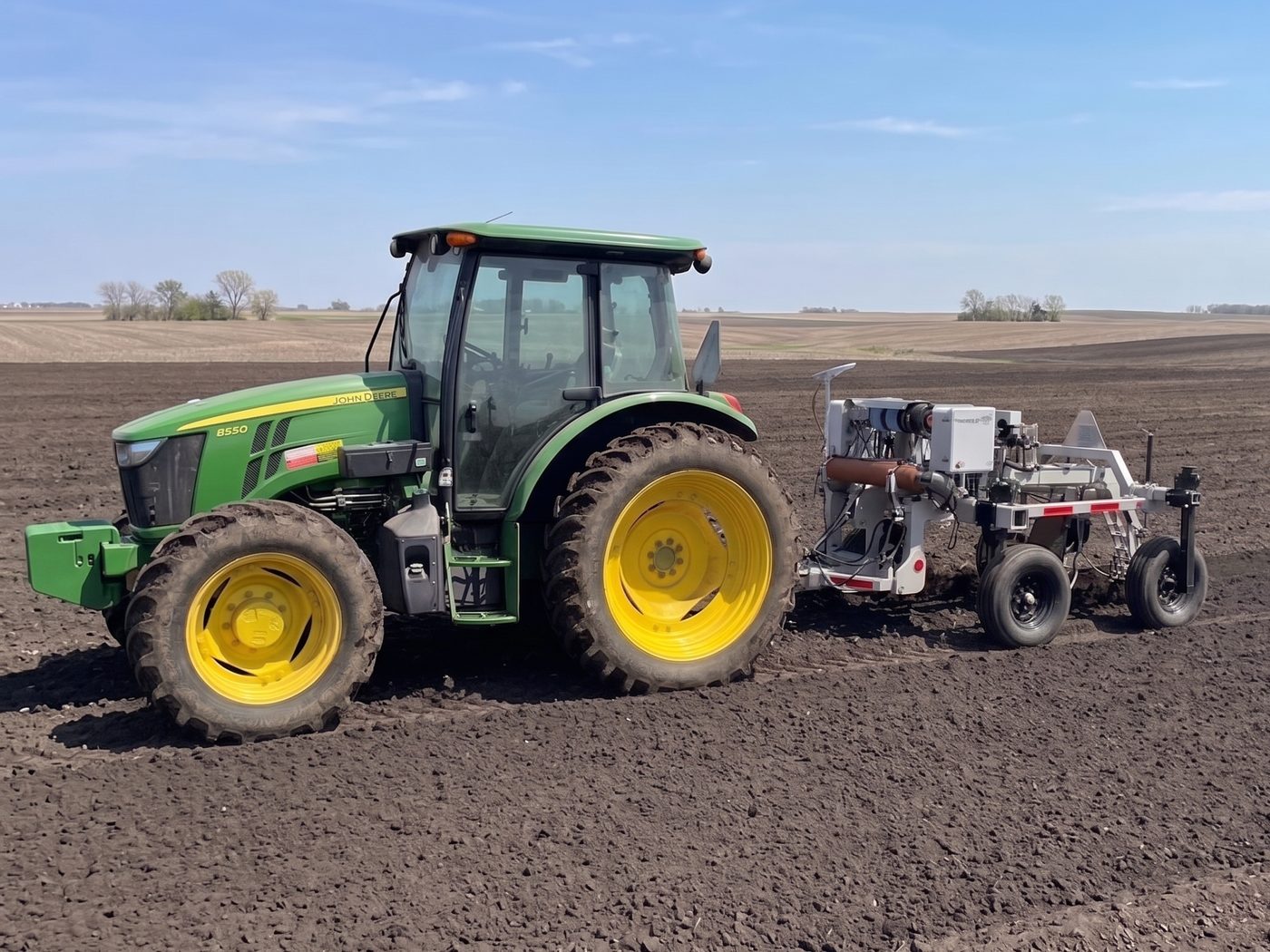
“This technology allows us to maximize productivity on every acre of soil without having to spend extra time to accomplish it. A dream.”
 Matt Coutts, Managing Partner, Coutts Agro Ltd. · TerraBlaster investor

Key specs
Accurate nutrient data, without the wait.
High resolution
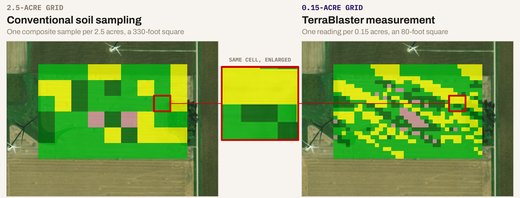
Maps at any resolution down to 0.15-acre grid resolution, or about 80 feet on a side.
Accurate
Precision that meets or exceeds lab measurement variation.
Multiple depth measurements
TerraBlaster measures at standard 0-6" depth. Many nutrients are stratified in the soil, so in addition to 0-6" the Blaster 1000 measures at every inch from 1 to 6 inches deep, so you can see if the nutrients the plants need are well distributed.
- P (ppm)Mehlich-3, Bray P1, or Olsen equivalents
- K (ppm)Ammonium Acetate or Mehlich-3 equivalents
- pHboth water 1:1 pH and salt pH (0.01 M CaCl2) available
- Buffer pHSikora
- Organic Matter (%)
- CEC (meq/100g)Cation Exchange Capacity
- Texture%sand, %silt, %clay
- Nitrate-N (ppm)
- Ammonium-N (ppm)
- Moisture (%)
- Total N (%)
- Total C (%)
- Total Organic Carbon (%)TOC
- Zn (ppm)DPTA or Mehlich-3
- Cu (ppm)DPTA or Mehlich-3
- B (ppm)hot water or Mehlich-3
- Mn (ppm)DPTA or Mehlich-3
- S (ppm)Mehlich-3
- Ca (ppm)Mehlich-3
- Mg (ppm)Mehlich-3
- Base saturation (%)
- Fe (ppm)DPTA or Mehlich-3
- Na (ppm)Mehlich-3
- Al (ppm)Mehlich-3
- EC (dS/m)1:1
Produce more data with less labor.
A manual crew samples at a fixed rate of roughly 20 sample grids per hour, regardless of resolution. So the finer the grid, the fewer acres they cover per hour. The Blaster 1000 measures continuously as it drives, so its acres-per-hour holds up far better at high resolution, and its advantage over manual sampling grows the finer you go.
From Mars to your field.
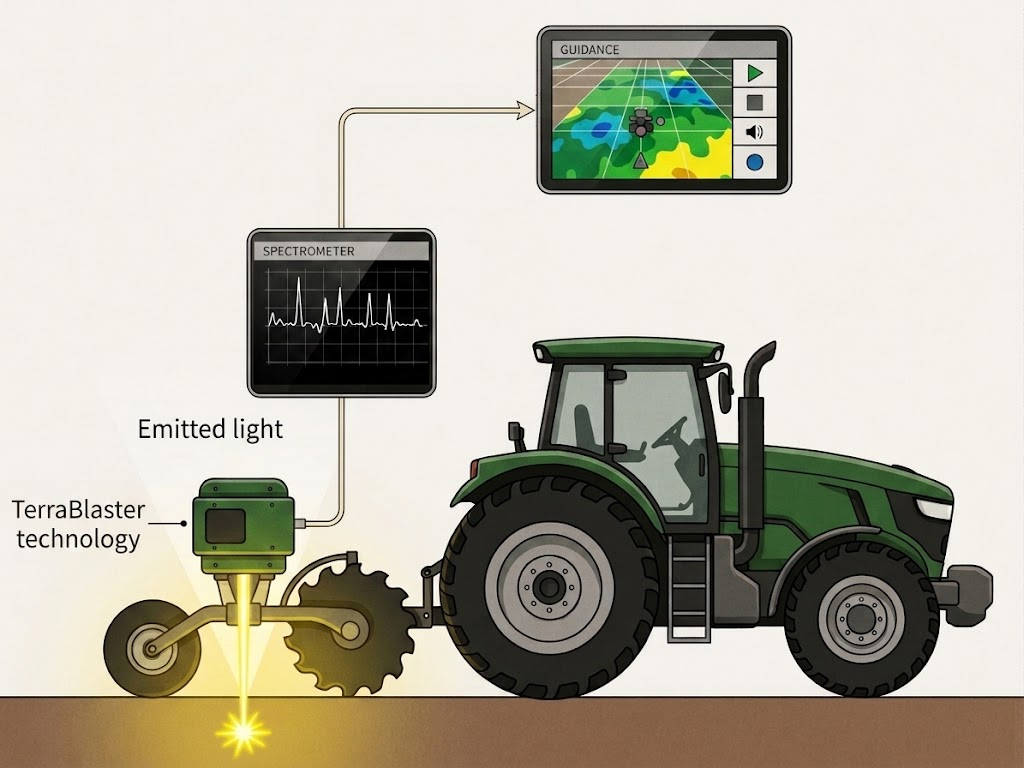
NASA perfected Laser-Induced Breakdown Spectroscopy (LIBS) to measure soil on Mars. Here's how we use it to measure your field:
- A laser pulse heats a pinpoint of soil into plasma
- Every element in that spot emits light at wavelengths that belong to it alone
- The spectrometer reads that light to determine exact soil composition
- The whole process repeats about twenty times per second
- Readings average over distance and are calibrated to soil type
The result? A very accurate spatial soil fertility map, generated from direct soil measurements, available almost instantly.
Want to see what precision looks like?
If you want to see what a TerraBlaster map looks like next to your lab results, reach out to us today.
Talk to our team →Limited beta systems.
We are running demos with growers and retailers across the Midwest this fall, on their fields and against their own lab results. What we learn there goes directly into the beta systems that will be shipped in spring 2027. A handful of slots remain for partners who want to participate.
Farm in Iowa? Request an on-farm demo this fall →